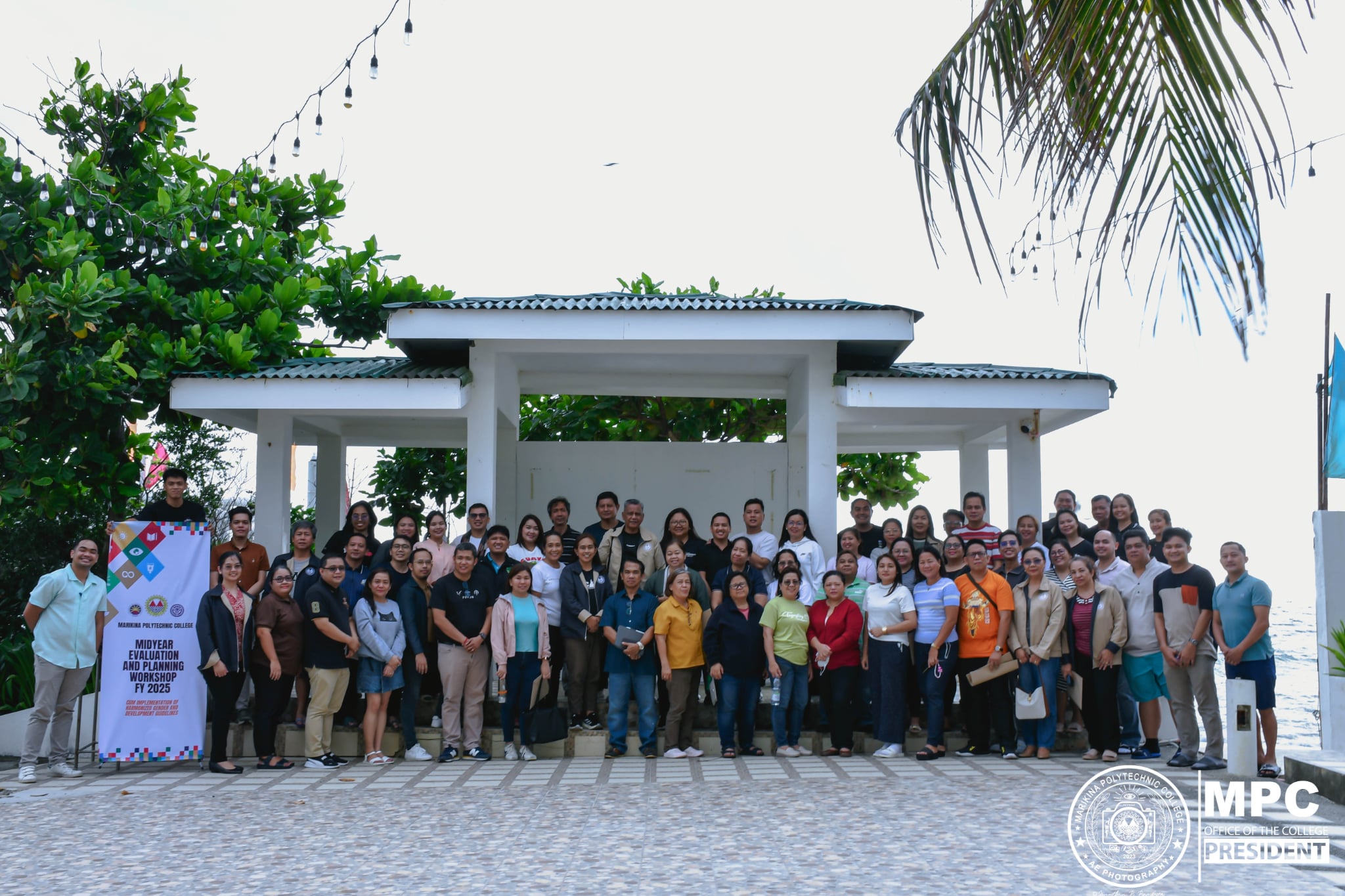
The Marikina Polytechnic College (MPC) recently conducted its Midyear Evaluation and Planning Workshop, a significant event aimed at assessing the institution’s progress and charting its course for the remainder of the year. The workshop was held over four days, with the first day taking place at the MPC campus, where management committee meetings were held across various domains.
The subsequent days, from Day 2 to Day 4, were held at the Treasures of Bolinao Beach Resort and Hotel in Pangasinan. The workshop commenced with an opening program, where Dr. Ronald Allan S. Mabunga, Vice President for Planning, Research, Extension, Linkages, Quality Assurance, and Partnerships (VPPRELQAP), delivered opening remarks. During his address, Dr. Mabunga highlighted the notable accomplishments of the PRELQAP Domain during his tenure at MPC and announced his formal return to his mother agency, the Philippine Normal University.
Dr. Rene M. Colocar, College President, expressed his heartfelt gratitude to Dr. Mabunga for his instrumental role in the college’s achievements, acknowledging his significant contributions to the institution’s growth and development. Prof. Deojames Roxas, Planning Director, oriented the participants on the workshop’s objectives, outlining the expected outputs and directions for the evaluation and planning process.
- Progress Report for the period January to June 2025 (by domain)
- Finalized OPCR 2025 and Revised or Recalibrated PAPs 2025
- Duly accomplished ROAAP and SWOT Analysis form
- Action Plans
GAD Director, Prof. Maricel L. Divina delivered the “GAD Talk: Implementing HGDG in Developing or Visiting PAPs”, successfully walking through the participants on the use of the adapted HGDG tool or template. Using the tool, the participants learned how much of the project’s budget can be attributed to the GAA-allocated GAD budget (i.e., 5% of the Agency’s GAA-Allocated Budget). Another template was presented by Planning Director, Prof. Deojames B. Roxas. The new template is to be used by project proponents in relation to the purchase or acquisition of items and equipment needed to implement a project which they have identified in their respective PAPs. Prof. Roxas also talked about the ROAAP, Swot Analysis, and Action Plan, emphasizing that the OPCR from January to June 2025 should have a properly filled out ROAAP tab in their respective new OPCR templates, since this will serve as inputs to future planning activities.
The recalibration of the each domain’s PAPs were done in consultation with the College’s Budget Officer, Ms. Maribeth Monsad. This workshop took place after Ms. Monsad’s presentation of the College’s Budget Utilization Rate (BUR).
Quality Assurance Director, Prof. Josephine Obispo, delivered her talk on THE Impact and the WURI, two more initiatives that the College shall be endeavoring to participate in. Preparations for the THE Impact is underway while the WURI might be shelved in favor of UI GreenMetric World University Ranking which might be more aligned with the current SDG initiatives of the College since it is a ranking on green campus and environmental sustainability. The UI GreenMetrics was initiated by Universitas Indonesia in 2010.
Key take aways for this Midyear Evaluation and Planning Workshop include the following:
- Proponents or offices under the VPAA domain with identified projects in their PAPs are to facilitate the purchase request not later than September 2025. Failure to do so shall mean forfeiture of the budget allocated for the project in their PAPs. Moreover, the forfeited budgets shall be realigned to other equally important projects that were shelved during the first approved PAPs.
- The Office of the President shall be signing Purchase Requests (PRs) only until October 15, 2025.
- Activities aligned with the Organizational Outcomes are funded from the GAA. This is augmented by funds coming from the STF, whose manner of spending is guided by CHED Memo
- College Targets aligned with the Organizational Outcomes For Higher Education Program (e.g., Percentage of first time takers who passed the licensure exam (70%), percentage of graduates (2 yrs. prior) who are employed (42%), percentage of undergraduate students enrolled in CHED-identified and RDC-identified priority programs (70%), percentage of undergraduate programs with accreditation (100%)) were set:
a. KRA 1: Curriculum and Instruction – MPC must secure COPC on its degree programs, pass programs and institutional accreditation, and qualify for SUC Level II
- 100% of Programs are accredited
- 50% of the Curricular Structures have been reviewed and enhanced
- One developed micro-credential program
- 100% COPC for graduate school
- 70% maintained and upgraded the Laboratory rooms, workshops, Classrooms and offices
- 50% of Academic Manuals have been reviewed and realigned with the current needs and/or have developed academic guidelines and policies
- Conducted at least 2 capacity-building activities for faculty and staff
- Conducted at least 2 capacity-building activities for students
- 42% of graduates (2 years prior) are employed
- 70% of undergraduate students are enrolled in CHED-identified and RDC-identified priority programs
b. KRA 2: Research and Development – enhance MPC’s visibility through research and publication
- 15 research outputs
- 5 research publications
- 2 issues of ISTRADOR
- 1 International Conference organized by MPC
- 2 capacity-building training programs on research and publication
c. KRA 3: Community Extension Services and Linkages -intensifying a more robust community engagement and enhancing national and international linkages
- 5 MOU/MOA with community orgnaizations
- 8 academic-led Extension Programs
- 8 research outputs for the community extension programs and partnerships
- 2 capacity-building training programs on community extension services
- Establishment of an MPC Internationalization Program Framework
- 2 new MOA/MOU with International Organizations
- 2 new MOA/MOU with National Organizations
- 2 capacity-building training on DRRM
d. KRA 4: Quality Assurance – increase MPC visibility through quality assurance
- COPC for all graduate programs
- ISO 9001:2015 QMS Certification (2nd Surveillance Visit)
- Level 1 Accreditation for EdD, BSECE, and BS Entrepreneurship
- 1 capacity-building program for faculty and staff
e. KRA 5: Good Governance and Management – institutionalization of a systems-based approach management
- Sustain ISO 9001:2015 Certification
- Promotion and/hiring of faculty based on Merit System (filling-up of unfilled positions)
- Promotion and/hiring of non-teaching personnel based on ROSSS
- Securing ISO 45001 (International Standard for Occupational Health and Safety Management System)
- 1 capacity training program for faculty and staff
- Completion of all deliverables (including installations for the SMART CAMPUS PROJECT
- Submitting reports to DBM, COA, etc. on time
- GAD Policies and Guidelines
- BOT-approved MPC Gender and Development 6-Year Development Plan
- 2 trainings on GAD-related programs
5. The new IPCR for the teaching and non-teaching staff shall be rolled-out this coming Academic Year 2025-2026.
6. A procurement team/committee shall be created.
7. Atty. Benitez shall be included as a BAC Member.
8. The College should have a working succession plan, in the likes of CSC Mentoring Program, to ensure business continuity.
The workshop served as a platform for MPC’s stakeholders to reflect on their progress, identify areas for improvement, and strategize for future growth and development. The event underscored the institution’s commitment to continuous improvement and its dedication to achieving excellence in education.
Photos: Day 1 | Day 2 | Day 3 | Day 4
MPC Records and Information Center
Photos: RIC and J. Bombita
Leave a Reply