Marikina Polytechnic College is developing a 10-year strategic plan to strengthen its technical and vocational education programs, upgrade trainer competencies and prepare its graduates for an increasingly technology-driven labor market.
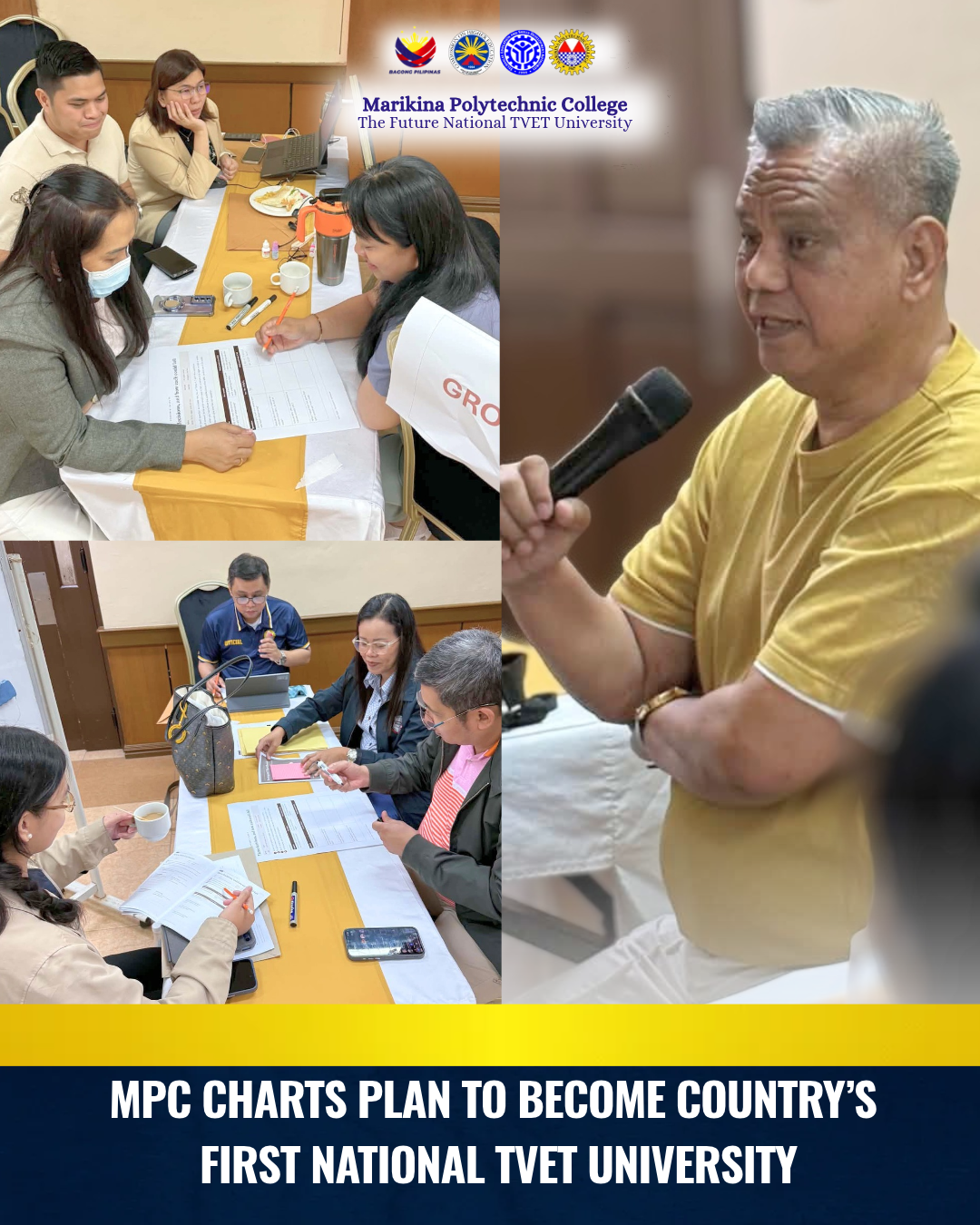
Organized by the Planning Management and Evaluation Office, this strategic initiative, “Phase 1-B: National TVET Academy of the Philippines Baseline Establishment, Strategic Intent, and Institutional Positioning Workshop” was participated by 25 college officials and administrative leaders on November 19, 2026 in Calamba, Laguna. Following the methodology, ‘Paglusad, Pagsaka, Pagsaad,’ this initiative comes as artificial intelligence reshapes industries and workplace requirements, prompting the College to reassess how it prepares both trainers/instructors and students for emerging employment opportunities.
A key concern raised during the workshop was the shortage of highly qualified technical trainers who possess both teaching competencies and substantial industry experience.
“The national bottleneck is trainers who can do what they teach,” Philippine Futures Thinking Society resident futurist Professor Emmanuel R. de Guia said.
Drawing on Organization for Economic Co-operation and Development research, Director of Futures Thinking and Strategy Foresight at the Northwest Samar State University Dr. Jonah L. Salcedo revealed that while 57% of lower-secondary teachers report that AI helps them draft or improve lesson plans, 37% use AI at work and 72% express concern over academic integrity.
These developments raised a critical question for MPC: whether its training programs can keep pace with emerging industries and equip workers with the competencies employers increasingly require.
Despite operating with one of the smallest budgets among state universities and colleges, MPC has attracted benchmarking visits from other universities interested in its technical training model. Hence, the college plans to maximize its resources while upgrading its laboratories, equipment, and facilities.
Among its proposed priorities is strengthening the qualifications of its workforce by requiring both teaching and non-teaching personnel to obtain Technical Education and Skills Development Authority (TESDA) National Certificates. It also plans to expand ladderized curricula and microcredentials, enabling students to accumulate technical qualifications that may count towards full degree programs.
MPC President Dr. Rene M. Colocar said that while attaining university status remains an important institutional aspiration, the greater challenge is demonstrating the capacity and readiness to fulfill that role.
“The challenge now is how to become. We need to look into the details of those processes because at the end of the day, time will come we are done already. By any other reason, we are done. But what exactly is the essence of serving people at this very moment? Later, that service of yours will be appreciated as part of your legacy as a distinct member of this institution,” Pres. Colocar shared.
Findings from the Second Congressional Commission on Education have highlighted gaps in trainer qualifications such as the limited industry experience of some instructors and the shortage of higher-level certifications in fields such as information technology, agriculture and automotive.
The challenge is relevant to Marikina. Registered footwear manufacturers in the city of 471,323 residents declined to 108 in 2025, employing 1,727 workers. At the same time, MPC shares its home city with TESDA’s National TVET Trainers Academy. Participants said MPC could help sustain the city’s footwear heritage by developing the next generation of skilled workers and entrepreneurs, framing the challenge as one of generational “succession, not rescue”.
The College already operates its FIT Research Lab and ReSOLES Technology Business Incubator, which graduated 14 start-ups under its second cohort in August 2026. Participants also confirmed the MPC’s potential role in strengthening the country’s pool of technical trainers through expanded instructor development programs in partnership with TESDA.
“The jobs will exist. The question is whether there will be anyone ready to teach people how to do them,” Prof. de Guia stated.
MPC Vice-President for Academic, Technical Education, and Skills Development Dr. Glen R. Mangali said that partner industries are closely watching how the institution equips the country’s technical educators.
“The country is looking at us as to whether we are really providing and supporting the trainers in the Philippines,” Dr. Mangali said.
Pres. Colocar said MPC must overcome the social stigma that views technical-vocational education as a second choice, urging the academic community to articulate a clear value proposition.
“The first thing that we need to win is the mindset of both teachers and students. Once you enter MPC, this institution should be the first choice. What exactly is our value proposition so people can imagine a better condition for themselves?” Pres. Colocar said.
Executive Vice President Engr. Sheila I. Villanueva stressed that the College’s proposals must be grounded in evidence, institutional readiness and its capacity to deliver, rather than the pursuit of institutional titles alone.
“Our goal is not simply to attain the designation of National TVET Academy, but to develop the competence, credibility and institutional capacity to fulfill the responsibilities it represents,” Engr. Villanueva said.
The planning workshop concluded with the awarding of certificates of participation to the resource speakers, led by Executive Vice President Engr. Sheila I. Villanueva, Vice President for Institutional Advancement and Quality Assurance Dr. Ma. Arra Santos-Bava, and Vice President for Corporate Services Dr. Joemel V. Bautista.#


What do you feel about this post?

Like

Love

Happy

Haha

Sad

Leave a Reply